 Informations about Samana and Dominican RepublicFrançais
The Dominican Republic occupies two thirds of the territory of the island « Hispaniola », the other third is occupied by the Republic of Haiti. Hispaniola is a word derived from « La Espanola » which was the original name given by Columbus to the island, he discovered Dec. 5th, 1492. This was the first land occupied by the Spanish in the New World.
The history of the Dominican Republic began with its first inhabitants the Taino. The Arawak tribe of Stone Age estimated at 250,000 souls to the arrival of Christopher Columbus December 5th, 1492, developed a sophisticated social order, including daily religious ceremonies, festivals and seasonal team sports.
They lived by hunting and fishing, agriculture, including tobacco mystified the first European conquerors, before they gain followers.
Dramatic new evidence about how these people were exterminated, emerge during archaeological excavations around the islands and interesting discoveries made in the National Park is near La Romana.
The popular tourist areas of the Dominican Republic are ...
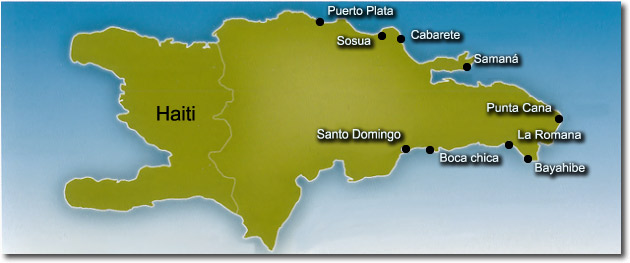
| Santo Domingo | Punta Cana | Puerto Plata |
| Sosua | Cabarete | Samana |
| Boca Chica | La Romana | Santiago |
| Bayahibe |
|
Population: |
With a population of 9,400,000 inhabitants, the country is divided into 26 provinces and one district |
|
Capital: |
Santo Domingo is the capital with more than 3,000,000 inhabitants. It is the largest city in the country |
|
Language: |
Spanish is the official language |
|
Religion: |
The predominant religion is Catholicism, although virtually all religions are represented |
|
Politics: |
The country has a democratic government with elections every four years |
|
Climate: |
Temperature can vary between 24° and 30° C. The hottest months are July and August and the coolest December and January. It is almost always sunny and the beach is open all year |
|
Economy: |
Main industry is tourism, followed by agriculture and, of course, rum production. Other industries: gold, silver, nickel, copper and bauxite mining |
|
Tip: |
In all hotels, it is acceptable to give tips, but the amount is entirely at the discretion of customers. In independent restaurants, the law requires 8% tax (ITBIS) and often 10% service charge is added to the bill. If you really appreciate the service, it is customary to add an additional amount |
|
Sports: |
Baseball is the national sport. Boxing, wrestling, basketball, cockfights and horse races are very popular among Dominicans |
|
Telephone and fax : |
As in all foreign countries, it is very expensive to make phone calls or send faxes from your hotel. If you plan to use these services, you must leave an imprint of your credit card upon arrival. Some hotels charge a service fee for receiving a fax. The regular fee for calls to Canada is $20 RD per minute at your hotel. You can also buy calling cards. These cards can be used with public telephones. DIRECT CANADA: 1-800-333-0111 (charges apply) |
|
Transportation: |
Bus
Local bus
Taxi
Car rental
|
|
Water: |
Do not drink tap water. Most hotels provide bottled water, and you can also buy bottles in the shops. Do not worry, the water you are served in bars, and restaurants is purified. Ice cubes are also made of purified water. |
|
Doctor: |
Most hotels offer paid medical services. Doctors make house calls (24 hours service). Contact the lobby for more information. |
|
Safety deposit box: |
In most cases this is a paying service, and hotels will accept no responsibility for valuables left out of the box. The fare is $4 per day at all the Gran Bahia Principe hotels. |
|
Cuisine: |
Dominican drinks
There are three types of rum ...
There are four kinds of beer in the Dominican Republic: Quisqueya, Presidente, Bohemia and Ambar). You can also find the Heineken, which is brewed on the island. Comedores: Small simple meals, Dominicans generally go there for lunch.
|
|
Sun: |
The sun, despite its benefits, can also cause minor problems. Always apply sunscreen properly to protect you from harmful UV rays. Disorders may occur as a result of prolonged exposure to sunlight (dizziness, vomiting, fever, etc.). You must protect yourself, especially the first few days and avoid prolonged sun exposure by wearing a hat and sunglasses. The sunscreen factor 30 should be used during your excursions and water sports. |
|
Currency: |
The currency is the Dominican Peso. The one located at the entrance of the Gran Bahia Principe had a rate of 30 to 1 (USD). Tips can be left in USD or DOP. For excursions, you pay in cash (USD) or credit card. In most hotels, you will find an exchange office where you can exchange money at the lobby. The hotel rates are not significantly different from those of the city. The U.S. dollar is accepted everywhere. The ATM cards accepted are Interac and PLUS. Remember that you can only withdraw money in local currency. Be sure to tell the bank that issued your credit card, you'll be in Dominican Republic BEFORE leaving. This will avoid you many problems! |
|
Time Zone : |
The Dominican Republic is located in the GMT -4. GMT stands for Greenwich Mean Time. |
|
Electricity: |
110 Volts 60 cycles.
|
|
Required Documents: |
The passport is not mandatory in the Dominican Republic (birth Vital with two cards with photo is required if you do not have a passport). Security at the airport in Samaná is as strict as our airports. You must remove your shoes, no liquids over 100ml, no belt. You should always bring a pair of socks, because it is really « icky » to walk barefoot all to pass the metal detector. Yeurk! You must fill out the Direccion General de Migracion before passing the customs on arrival. It is not allowed to take photos BEFORE you cross the border.
|
|
Entry tax in the country: |
$ 10 USD per person. You receive a coupon aboard the plane going to the Dominican Republic. However, many tour operators included this expense while purchasing your travel package. |
|
Health: |
There is no vaccine mandatory for entry. However, it is still recommended to consult a clinic for travelers. Twinrix must be considered if you travel frequently outside the country, it protects against hepatitis A and B. Some people choose to take the drug against malaria (chloroquine), because there was an outbreak (few recorded cases) few years ago after a tropical storm that left standing water in the region of Punta Cana. The state of public health is considered very good by the World Health Organization and other agencies. |
|
Post: |
You can buy stamps in the souvenir shops. Your postcards can take up to three weeks to reach the destination. Usually you found a place to post them in the lobby. |
|
Shopping and souvenirs: |
Larimar
Amber
Dolls
Black coral
Carved wood
Paintings
Braids
Other souvenirs
|
|
National parks: |
Parque Nacional Monte Christi
|
Source: Books of TMR, VAT and VAC at the hotels Gran Bahia Principe El Portillo and Cayacoa and our personal assessments.